My father sent this to me, and after watching it I had to post it here at our blog to show all of our readers this amazing video. It is a fantastic representation of the inner workings of an automatic firearm, specifically the AK-47. Don't take my word for it, watch this short minute and a half long video!
Showing posts with label Firearms. Show all posts
Showing posts with label Firearms. Show all posts
Monday, October 24, 2016

Blog Archives: NFA Weapon Classes Explained
Originally Posted on November 5th, 2013
I decided that my response to the question (What are Class 1, 2, 3, 4 and so on Weapons and an example of each?) was so accurate, detailed and necessary that it deserved its own post here at the Crow Flies blog. Without further ado, I present to you the Question and Answer of the Day:
Question: What are Class 1, 2, 3, 4 and so on Weapons and an example of each?
Answer: I will answer this question correctly and as best as I can. The NFA (National Firearms Act enacted on June 26th, 1934) classifies all weapons that are sold, manufactured, imported, exported or owned by Americans, into 4 major Categories. A Weapon is defined as: any instrument or tool that can be fashioned and wielded for the purpose of killing (animal or human) or inflicting bodily harm on others. It is by this definition that the TSA is able to call a box knife (a tool most commonly used for cutting boxes and tape off of packages) a weapon, since it was used one time to hijack an airplane. Now that you have some background on what a weapon is, it's time to define the different classes of weapons as outlined by the NFA.
Class I Weapons - handguns, rifles, and shotguns that are imported into the United States are defined as Class 1 Weapons. In order to import these weapons one must hold a Class 1 FFL (Federal Firearms License). It should be noted that Class 1 Weapons are generally semi-automatic (one pull of the trigger fires one bullet) only as all fully-automatic (one pull of the trigger fires multiple bullets) weapons are no longer being imported into the United States, as of 1986. However, a Class 1 Weapon can legally be converted to a Full-Auto firing mechanism once it has been imported, but only by a properly licensed Class III FFL Manufacturer and only after BATFE (Bureau of Alcohol, Firearms, and Explosives) approval. An example of this would be a Full-Auto AK-47 imported post-1986. These are rarely found legally owned in the US. However, the Full-Auto AK-47 is a very common weapon in the US, but almost all owners, obtained the weapon illegally. Since, the AK-47 is a Russian/Eastern Bloc Weapon, after the Berlin Wall fell in '86 millions of these carbines were sold to Mexico and other Latin American nations. Thousands of these rifles are smuggled into the US daily to help arm Muslim Terrorists fighting for Allah on American Soil.
Class II Weapons - handguns, rifles, shotguns, and silencers that are manufactured within the US. These Class 2 Weapons are semi-automatic only, meaning that each time the trigger is pulled only one round is fired from the barrel. It should be noted that in order to manufacture a silencer one must hold a Class II FFL but in order to sell silencers you must have a Class III FFL. Also, in order to purchase and own a Silencer, one must apply for a Class III NFA Tax Stamp (a $250 fee paid to Uncle Sam) with the BATFE. It is for these reasons that Silencers are so often mistaken for being illegal or only sold to military and LEO's (since Class III FFL Dealers are not as abundant as Class II FFL Dealers).
Class III Weapons - Short Barreled Rifles (SBR's), Short Barreled Shotguns (SBS's), and Fully Automatic Rifles and Handguns are classified as Class III Weapons. Short Barrel describes firearms with a butt-stock and having an Overall Barrel length of less than 16" from muzzle to breech. Because of the Short Barrel definition, one can reasonable conclude that attaching any type of stock to a pistol would then classify it as a SBR or Short Barreled Rifle which then makes it a Class III Weapon. If the pistol we are describing was just a regular handgun purchased from a Class II dealer, it would be illegal to make it a Class III SBR by attaching a stock to it, without filling out the appropriate paperwork first and applying for the NFA Tax Stamp. All NFA Violations such as this one, as Class Y Felony's punishable by a $100,000 fine and a 10 Year minimum prison sentence. Fully Automatic Weapons are those that fire multiple (more than one) bullet with a single pull of the trigger. These weapons are legal to own in the United States by non-felon, Class III Licensed citizens and are sold only by Class III FFL dealers.
Class IV Weapons - The last and highest class of Weapons, sometimes referred to as Class 4, covers what the NFA calls, Destructive Devices or DD's. Destructive Devices are bombs, grenades, nuclear weapons, flame throwers, dynamite, rocket launchers, tanks, Javelin Missile Launcher, Harrier Jets, and so on and so forth. Class 4 Weapons or DD's cover anything that explodes, shoots flames, or launches an exploding device. Class IV weapons are illegal to own, manufacture, sell, trade, import, export, or own parts for, by any American citizen other than properly licensed LEO's, Military, and government officials.
I hope that this info will clarify some of the things you may have been wondering or maybe never knew. I know there are many new Gun Owners out there that want the biggest, coolest, and baddest looking gun and features, sometimes they buy things that would make their gun illegal to own and without knowing the NFA laws, this can get you into some serious trouble. One mistake such as the one described under Class III Weapons with the Pistol and stock attachment, could cost you a LOT! A felon, can never own another gun again, can NEVER purchase another gun, can NOT vote, can NOT serve in the Military, and can NEVER leave the United States....even for Vacation. Do your research before attaching that awesome new accessory you ordered off the internet to your gun and taking it to the range! This does bring me to another issue, just because it is sold legally at the gun store or on the internet, DOES NOT mean it is legal for you to own! For example: A Full Auto Trigger Group for an AK-47 or AR-15 can be purchased for under $30 from various retailers online. It can be purchased and shipped directly to your house via US Mail, no questions asked, and this is perfectly legal. However, these parts are sold for those who LEGALLY own a Class III Weapon (Full Auto firearm) and are ILLEGAL for those who don't own a LEGAL Class III Weapon to have in their possession. The law is very specific in how and what it states. The exact rules of the law will be explained in this next description:
Let's say you own an AR-15 with a 16" barrel that you bought at the local gun store.
A friend of yours who just sold his last AR-15 has some extra/spare parts lying around that he gives you since he has no use for them anymore. One of these is a short 7.5" barrel. It is perfectly legal for you to own a 7.5" AR-15 barrel, you could use it to build an AR Pistol. However, the fact that you don't currently have a dedicated AR Pistol receiver in your possession, the only AR-15 receiver you do have is the one that you just bought that has the 16" barrel on it, makes having possession of this 7.5" barrel an iffy ordeal. According to the NFA law, which I encourage everyone to read (it's only several hundred pages long), having possession of this Short 7.5" barrel that will fit on your current Rifle Length 16" AR-15, gives you the ability to convert your current AR-15 into a SBR (Short Barreled Rifle) which is a Class III Weapon. This is a prime example of how not knowing the law could cost you your guns and life. How can we make this scenario legal you ask? Simple! Go to the gun store, purchase a "Stripped AR Lower" and a "Stripped AR Upper", keep your 7.5" barrel stored in the same place as the two Stripped AR Receivers but separate from you 16" barreled AR-15.
If for some reason the police or ATF were in your house and saw this 7.5" barrel, they would see that you are in the process of building an AR pistol (you will probably have to tell them this is what you are doing) and it is perfectly fine for you to own these parts now. Using this example you can swap the 7.5" barrel for many other parts that are available for you to purchase and apply the same concepts. Going back to the Full Auto trigger group, if you have possession of a Full Auto Trigger Group in your parts kit that you take to the range with your new 16" barreled AR-15 that you bought at the local gun store, you are breaking the law! The ATF says that you could easily (even though there is nothing easy about it) convert that AR-15 into a Full Auto M16 by installing the Full Auto Trigger Group into it. What makes this scenario legal? If you own a properly licensed Class III M16 that you have the paperwork for, then you can also have that Full Auto Trigger Group in your parts kit/tool box that you take to the range, even if the M16 is not with you, but back at home in your safe. You just need to make sure that you have proof of the paperwork to show in case the ATF asks.
Looking back, we have determined what a Weapon is, described the different classes (categories) of weapons as defined by the BATFE in the National Firearms Act, given examples of each, and then wrapped everything up by applying some real world scenarios to the different laws defined by the NFA. Now you are aware that the NFA is not a person, nor is at a government body, it is a set of laws that govern all firearms on US Soil, even those carried by Foreign diplomats. I would like to end this post by telling you what brought the NFA into existence - this is by far my favorite Firearms fact. World War I, the Great Depression, and Prohibition gave rise to many advances in technologies especially those regarding firearms as well as rise to a new culture and breed of individuals. Like modern times, where people want the latest and greatest technology in the lightest and most compact form factor available, the people of the 1920's and 30's wanted the same, in fact, it is safe to say, this has always been a desire among man in regards to technology. World War I brought about many new weapons and refinements to current platforms, for example, the Fully Automatic Machine gun, capable of firing 800 to 1000 bullets a minute, was now not restricted to bulky vehicle mounted armaments but could now be held by a single man and fired while the man was at a full sprint! Guns like the Thompson Submachine Gun fit this bill and could be purchased at the local hardware store for $25 by anyone that could see over the counter. Check out these ads pulled from period specific Newspapers.
The ad below was targeted toward security guards, police, and homeowners, as it describes the Tommy Gun as the Thompson Anti-Bandit Gun!

 The Ad on the left was targeted toward Hunters and Plinkers. The Thompson Submachine gun was an instant success when released in 1919, even though the US Military didn't pick it up until 1938 for WWII, the streets of every major US City were flooded with Thompson Submachine Guns. No Bootlegger was without one, even farmers and ranchers purchased them as a means of fending off coyotes (this was another use of the Tommy Gun depicted by a 1922 Thompson Advertisement, not seen here). US LEO's and J Edgar's G-Men were still carrying 6 shot revolvers, and SWAT teams hadn't even been thought of yet. Government officials were being mowed down daily and every time, it was by Thompson's new Submachine Gun. The Gangs of New York and Chicago were especially notorious for outfitting their workforce with Tommy Guns instead of pistols. It was due to the high number of Government employees who died as a result of the Tommy Gun that in 1934 the 72nd Congress drew up and enacted the NFA. This made the Tommy Gun a Class III weapon and to own one, you would have to submit a photo id, fingerprints, and pay the $250 Tax to the ATF (at the time probably the new FBI). This made it especially difficult for the felons to purchase them and those that didn't have lots of money, especially since the tax was 10 times what the gun cost new! It didn't stop people like Al Capone from purchasing them though. Those that already owned a Tommy Gun were grandfathered in and were not subject to the NFA unless the attempted to sell the weapon. It should be noted that in 1938 the Thompson Submachine Gun went into service with our Men and Women of the Armed Forces and was carried on the shores of Normandy to the Jungles of Vietnam. It was later replaced by the M16, but that is a different story altogether. I have always been fascinated by the politics, culture, and state of our country from 1920 to 1939 and often wish I would have been alive to see that period. It is because of this that I find the above facts to be the most fascinating. Culture, Politics, and Crime all played a part in leading up to the formation of the NFA. If the US hadn't gone through the Great Depression, Prohibition might never have happened, gangs and unions might not have been so influential, and the Thompson gun may have just been a Badass Coyote Killer! If you have any questions or comments feel free to post in the comments section below as it is open for everyone, guests included or you can email me at kellym.crow@gmail.com. If you would like to subscribe to my blog and be notified via email of future posts please email me a blank email with the subject line SUBSCRIBE ME. Thanks for reading!
by Kelly Crow
This is another article pulled form the archives of the old blog, By the Way the Crow Flies. Over the next few months we will be moving a few articles over from the old blog as part of our "Blog Archives" series - Enjoy!
If anyone has recently watched the movie "The Purge" that was released On Demand, Redbox and iTunes around Halloween, then you may be familiar with the text displayed by the US Government on the TV Screens of US Citizens in the movie. Without revealing any spoilers for those of you who haven't seen the movie, I would like to give a VERY brief description of the plot. The Purge takes place in the US in the year 2022. Due to the overwhelming growth of poverty, homelessness, and crime, the Federal Government declared one night a year, known as "The Purge", for any crime to be legal! That's right, everything that is illegal is legal for one night a year, from 7pm to 7am....even murder. The Purge begins at 7pm with the sound of the Air Raid/Tornado Sirens every American City has in place and an Announcement made by the Federal Government on Television. The announcement basically states that....All crime is legal and fair game for the next 12 hours, there will be no police, no fire trucks, and no ambulance on duty until 7am the next day. All Weapons up to Class 4 may be used, anything over Class 4 is still illegal for use during The Purge. And that's about all I am going to tell you. Being a firearms aficianado myself, I am familiar with Class 2 and 3 weapons, and I could guess what Class 4 Weapons are but I wanted to find out with a quick Google search. Googling "Class 4 Weapons" brought up a bunch of questions, directly related to the movie "The Purge". People all over the web want to know what Class 1, 2, 3, 4, and so on Weapons are and an example of each. The first one I clicked on was at Yahoo Answers, and the two answers given were completely retarded, and the one that was voted "Best Choice" was completely INCORRECT! This disturbs me, the fact that ignorant and uneducated people that know nothing about what they are saying, are in fact saying things and trying to answer questions which they shouldn't be answering. I answered a couple of these questions using the National Firearms Act of 1934 as my reference and info from the BATFE website. I actually did my research before answering the damn question, even though I had an idea of what the answer was before. When someone asks a question, it should be answered with fact and supporting evidence, it should state the sources of information. Answers to questions, especially at sites like Yahoo Answers, should NEVER be an opinion with the source "First Hand Knowledge".I decided that my response to the question (What are Class 1, 2, 3, 4 and so on Weapons and an example of each?) was so accurate, detailed and necessary that it deserved its own post here at the Crow Flies blog. Without further ado, I present to you the Question and Answer of the Day:
Question: What are Class 1, 2, 3, 4 and so on Weapons and an example of each?
Answer: I will answer this question correctly and as best as I can. The NFA (National Firearms Act enacted on June 26th, 1934) classifies all weapons that are sold, manufactured, imported, exported or owned by Americans, into 4 major Categories. A Weapon is defined as: any instrument or tool that can be fashioned and wielded for the purpose of killing (animal or human) or inflicting bodily harm on others. It is by this definition that the TSA is able to call a box knife (a tool most commonly used for cutting boxes and tape off of packages) a weapon, since it was used one time to hijack an airplane. Now that you have some background on what a weapon is, it's time to define the different classes of weapons as outlined by the NFA.
Class I Weapons - handguns, rifles, and shotguns that are imported into the United States are defined as Class 1 Weapons. In order to import these weapons one must hold a Class 1 FFL (Federal Firearms License). It should be noted that Class 1 Weapons are generally semi-automatic (one pull of the trigger fires one bullet) only as all fully-automatic (one pull of the trigger fires multiple bullets) weapons are no longer being imported into the United States, as of 1986. However, a Class 1 Weapon can legally be converted to a Full-Auto firing mechanism once it has been imported, but only by a properly licensed Class III FFL Manufacturer and only after BATFE (Bureau of Alcohol, Firearms, and Explosives) approval. An example of this would be a Full-Auto AK-47 imported post-1986. These are rarely found legally owned in the US. However, the Full-Auto AK-47 is a very common weapon in the US, but almost all owners, obtained the weapon illegally. Since, the AK-47 is a Russian/Eastern Bloc Weapon, after the Berlin Wall fell in '86 millions of these carbines were sold to Mexico and other Latin American nations. Thousands of these rifles are smuggled into the US daily to help arm Muslim Terrorists fighting for Allah on American Soil.
Class II Weapons - handguns, rifles, shotguns, and silencers that are manufactured within the US. These Class 2 Weapons are semi-automatic only, meaning that each time the trigger is pulled only one round is fired from the barrel. It should be noted that in order to manufacture a silencer one must hold a Class II FFL but in order to sell silencers you must have a Class III FFL. Also, in order to purchase and own a Silencer, one must apply for a Class III NFA Tax Stamp (a $250 fee paid to Uncle Sam) with the BATFE. It is for these reasons that Silencers are so often mistaken for being illegal or only sold to military and LEO's (since Class III FFL Dealers are not as abundant as Class II FFL Dealers).
Class III Weapons - Short Barreled Rifles (SBR's), Short Barreled Shotguns (SBS's), and Fully Automatic Rifles and Handguns are classified as Class III Weapons. Short Barrel describes firearms with a butt-stock and having an Overall Barrel length of less than 16" from muzzle to breech. Because of the Short Barrel definition, one can reasonable conclude that attaching any type of stock to a pistol would then classify it as a SBR or Short Barreled Rifle which then makes it a Class III Weapon. If the pistol we are describing was just a regular handgun purchased from a Class II dealer, it would be illegal to make it a Class III SBR by attaching a stock to it, without filling out the appropriate paperwork first and applying for the NFA Tax Stamp. All NFA Violations such as this one, as Class Y Felony's punishable by a $100,000 fine and a 10 Year minimum prison sentence. Fully Automatic Weapons are those that fire multiple (more than one) bullet with a single pull of the trigger. These weapons are legal to own in the United States by non-felon, Class III Licensed citizens and are sold only by Class III FFL dealers.
Class IV Weapons - The last and highest class of Weapons, sometimes referred to as Class 4, covers what the NFA calls, Destructive Devices or DD's. Destructive Devices are bombs, grenades, nuclear weapons, flame throwers, dynamite, rocket launchers, tanks, Javelin Missile Launcher, Harrier Jets, and so on and so forth. Class 4 Weapons or DD's cover anything that explodes, shoots flames, or launches an exploding device. Class IV weapons are illegal to own, manufacture, sell, trade, import, export, or own parts for, by any American citizen other than properly licensed LEO's, Military, and government officials.
I hope that this info will clarify some of the things you may have been wondering or maybe never knew. I know there are many new Gun Owners out there that want the biggest, coolest, and baddest looking gun and features, sometimes they buy things that would make their gun illegal to own and without knowing the NFA laws, this can get you into some serious trouble. One mistake such as the one described under Class III Weapons with the Pistol and stock attachment, could cost you a LOT! A felon, can never own another gun again, can NEVER purchase another gun, can NOT vote, can NOT serve in the Military, and can NEVER leave the United States....even for Vacation. Do your research before attaching that awesome new accessory you ordered off the internet to your gun and taking it to the range! This does bring me to another issue, just because it is sold legally at the gun store or on the internet, DOES NOT mean it is legal for you to own! For example: A Full Auto Trigger Group for an AK-47 or AR-15 can be purchased for under $30 from various retailers online. It can be purchased and shipped directly to your house via US Mail, no questions asked, and this is perfectly legal. However, these parts are sold for those who LEGALLY own a Class III Weapon (Full Auto firearm) and are ILLEGAL for those who don't own a LEGAL Class III Weapon to have in their possession. The law is very specific in how and what it states. The exact rules of the law will be explained in this next description:
Let's say you own an AR-15 with a 16" barrel that you bought at the local gun store.
 | |
| Stripped AR Lower Receiver - Class II Weapon |
 | |
| Stripped AR Upper Receiver - Not Classified |
Looking back, we have determined what a Weapon is, described the different classes (categories) of weapons as defined by the BATFE in the National Firearms Act, given examples of each, and then wrapped everything up by applying some real world scenarios to the different laws defined by the NFA. Now you are aware that the NFA is not a person, nor is at a government body, it is a set of laws that govern all firearms on US Soil, even those carried by Foreign diplomats. I would like to end this post by telling you what brought the NFA into existence - this is by far my favorite Firearms fact. World War I, the Great Depression, and Prohibition gave rise to many advances in technologies especially those regarding firearms as well as rise to a new culture and breed of individuals. Like modern times, where people want the latest and greatest technology in the lightest and most compact form factor available, the people of the 1920's and 30's wanted the same, in fact, it is safe to say, this has always been a desire among man in regards to technology. World War I brought about many new weapons and refinements to current platforms, for example, the Fully Automatic Machine gun, capable of firing 800 to 1000 bullets a minute, was now not restricted to bulky vehicle mounted armaments but could now be held by a single man and fired while the man was at a full sprint! Guns like the Thompson Submachine Gun fit this bill and could be purchased at the local hardware store for $25 by anyone that could see over the counter. Check out these ads pulled from period specific Newspapers.
The ad below was targeted toward security guards, police, and homeowners, as it describes the Tommy Gun as the Thompson Anti-Bandit Gun!


Thursday, September 1, 2016
Blog Archives: My Quest for the Ultimate Tactical .45
 |
| Springfield Long Beach Operator 1911 |
by Kelly Crow
This is an article that was written and posted to the old blog, By the Way the Crow Flies, but it had a ton of page views and was very informative. Over the next few months, we will be moving a few articles over from the old blog as part of our "Blog Archives" series - Enjoy!
Recently I had the great pleasure of being able to trade my Remington R1 and a Glock 19 for the most amazing production model Springfield Operator I've ever laid eyes on, a Springfield Loaded Operator Long Beach Police Department Mod 1911. I'm a huge advocate of Springfield's firearms, especially their 1911's - not so much the XD's (I have always been a Glock Fanboy when it comes to Polymer pistols) but I've heard great things about the XD .45's and the XDm in all calibers. Springfield Armory is well known for their extensive lineup of 1911's and M1A/M14 rifles. These two weapons systems are where they excel in my opinion and the rest of their product line is just to retain market share and brand saturation (I'm not knocking the XD and XDm - I've shot both, just wasn't a fan). Anyways, since I love Springfield 1911's I'm always at their website and I know their current product line like the back of my own hand.
The Search for the Ultimate Tactical .45ACP
 |
| HK Mark 23 |
HK Mark 23, but it was way out of the price range I was looking for, then I went to the HK USP .45, but it sure seemed expensive for a polymer pistol and it doesn't have a picatinny or universal rail. It has some weird HK propriety designed rail that requires the use of adapters for all lights/lasers - can
 |
| Glock 21 |
 |
| FN Herstal's FNX-45 Tactical |
The more I thought about what I truly wanted and needed from a Tactical .45, the more I realized that
 |
| Springfield Loaded Stainless Steel 1911 |
 |
MEUSOC 1911 built by Marine Armorers from a WWI Era
Ithaca frame and mid-1980s Springfield slide.
|
 |
Colt's Rail Gun won the MARSOC contract a few years back.
The new Marine pistol, the M45A1, is a SS Colt Rail Gun like
the one pictured above, but finished in Cerakote's Desert Sand
and dons G10 Grips to match.
|
The Ultimate Tactical 45 Specifications
- Full Size (Government Model) 1911 Handgun
- Barrel Length of at least 5 inches
- Magazine Capacity of at least 8 rounds
- Picatinny Rail
- Must have Non-Adjustable Night Sights (Novak's preferred)
- All steel Frame and Slide (Stainless or Carbon doesn't matter but must be durable)
- Can have a threaded barrel but not a must
- Should have a lanyard loop but not a must either
- Accurate and extremely reliable
- Should have a next-gen firearm coating to prevent rust and provide adequate lubricity
- Must be a Service/Duty Pistol that is currently in use by a US Gov Official/Soldier or State LEO
These specs really narrow the gap down, especially if I say it should also be a Springfield Armory
 |
| Springfield Loaded MC Operator |
How the Long Beach Police Operator Came to Be
The Long Beach, California Police Department sent an RFQ to Springfield for a custom spec'd gun very similar to the MC Operator. They wanted it all Black, with 10-8 Performance Grips and to come with a magwell. Originally when the RFQ was sent they were requesting enough of these guns to be able to issue one for each officer in the entire city, so several hundred at most. Springfield made the arrangements, entered into a pre-contract with LBPD, and started to build these fine pistols. Now,
 |
Springfield Professional Operator 1911, the handgun
used by select FBI and DEA Agents, is built
by Springfield's Custom Shop Master Gunsmiths
|
An In-Depth Look at The Long Beach Operator and it's Parts
 |
| Springfield Long Beach Police Operator field stripped. Note that the recoil spring guide rod has been swapped out for a Wilson Combat Bulletproof version, made from a Tool Steel Billet. Not only is it much thicker and heavier, but also secures to the recoil spring better than the stock part. |
Springfield spared no expense with this handgun. They start by using one of their highly sought after NM (National Match) serial numbered frames with an integral picatinny rail and then they pair it with an Operator slide. Both the frame and slide receive a coating of their trademarked Armory Kote finish in Satin Black. Yes, I'm aware many think that Armory Kote is nothing more than Gun Kote, especially since the colors are identical between the two, and this could quite possibly be, but I do not know so I'm referring to it as their propriety coating, Armory Kote for the remainder of the article. The slide contains a titanium firing pin as is used in all of their Loaded model 1911's, as well as Novak Night Sights which contain Trijicon's Tritium for that cool glow in the dark effect we all like so much! The extractor fits snuggly and is not quite flush fitting on the back of the slide but it's close. The slide stop also features a snug fit that could only be achieved by hand fitting. The barrel is Springfield's NM Stainless Steel .45 ACP barrel that are used in their Loaded and Trophy Match
model 1911's. A stainless barrel bushing is used and a standard GI recoil spring plug and spring guide, both finished in the same Satin Black Armory Kote as the Slide and Frame are finished in. Recoil Spring weight measures 16.5lbs and appears to be built from Chrome Silicon. This gun, like all Springfield 1911's is a series 70 style 1911 so it does not feature the firing pin plunger that is used to prevent the firing pin from moving unless the trigger is pulled. I'm not going to get into a debate on Series 70 and Series 80 1911's, I've owned both and I've never had issues with either, but I do prefer the Series 70 due to less moving parts, which in turn means less stuff to break and/or maintain.
 |
| Springfield Long Beach Police Operator Slide with Barrel. |
Moving down to the frame - this 1911 features Springfield's three hole slotted Lightweight Aluminum
Match Grade trigger and Springfield's standard sear and internals found on all Loaded models as well as a Delta style hammer. A flat, checkered mainspring housing featuring Springfield's ILS is installed with a bolt-on style maxwell attached to the bottom. The front of the grip is smooth and has no checkering. A S&A high ride grip safety has been hand fitted and blended to the frame with moreattention to detail than the one installed on my SS Loaded. The Long Beach Operator has a Wilson Combat Ambidextrous Safety identical to the one installed on the Custom Shop Professional model. The slide stop is the standard Springfield slide stop found on all Loaded model 1911's. Springfield installed an extended ejector like they do on most Loaded models, however this one has been pinned to the frame unlike the ejector on my SS Loaded. The inside of the frame and slide are immaculate, with superb attention to detail there are no machine or file marks, and the feed ramp is smooth and polished. Of course since this is an Operator model 1911 the front of the frame features the integral picatinny rail with 3 rail indentations offering a high level of flexibility when choosing laers/lights.
 |
A view of the Long Beach Police Operator
frame from the top, looking down into the
frame. The lighting makes it difficult to see,
but the feed ramp is polished to a mirror shine.
|
 |
View of the ejection port side of the Springfield Long Beach
Police Operator
|
Optional Mods
Before I went out to shoot my new Long Beach Operator I made a few mods that I feel are necessary for reliability and to enhance shooting. Wilson Combat sells what they call a "1911 Reliability Kit" it's a bunch of springs to enhance overall reliability and to rebuild or respring a 1911. I took some of my mods from the reliability kit and I change out at least two springs on every 1911 I buy, yes, even
 |
| Left side view of the Long Beach Police Operator with a Surefire X300 Ultra installed and VZ's Slant Tiger Stripe G10 Grips |
Besides springs I changed out the recoil spring guide rod with a Stainless Wilson Combat Bullet Proof version. Wilson's Bullet Proof line of 1911 parts are cut from a block of tool steel which allows them to don the Bullet Proof name. The factory recoil spring guide from Springfield is made from
carbon steel and is hollow through the center, and could very possibly be a MIM part. While the factory recoil spring guide is sufficient for shooting this pistol, remember I was looking for the Ultimate Tactical .45 and part of it being "Ultimate" is that the internals need to be extra tough, I don't want parts breaking and I feel like Wilson's Bullet Proof line of parts enhance reliability as well. I also changed out the grips with a pair of VZ Slants in their Tiger Stripe G10 pattern. I prefer VZ Grips on my 1911's and have used their Recons, Operators, and Aliens so I decided to try out a pair of the Slants. They feel and look great, especially when shooting with gloves which is how I do the majority of my shooting.
 |
| Ejection port side view of Springfield LB Police Operator |
Though it did not necessarily need it, I decided to polish the barrel chamber and feed lip. I started with 1000 grit wet paper, moving up through the grits until I finished with a 10,000 grit cloth based
paper. It left a mirror shine. I also run a bit of JB Bore Polish down the barrel several times to really clean it up. The barrel did appear to not have been cleaned after test firing at the factory, polishing it really cleaned and shined it up. I had a Guncrafter Ind's Flat Checkered Mainspring Housing with Integral Lanyard Loop in the toolbox, so I attempted to install it on the Long Beach Operator to use with my Gemtech Lanyard. After installing it and seeing the color difference between the blued Guncrafter MSH and the Armory Koted Springfield MSH, not to mention losing my magwell, I decided to keep the stock setup here. Like I said before, a lanyard loop was not an absolute must but it's nice to have on a tactical handgun. Someday I may in fact go back to the lanyard loop MSH when I'm ready to get the gun recoated in Armory Kote Satin Black.
 |
| Left side view of Springfield LB Police Operator |
Range Results and Impressions
I finally got a chance to fire the Long Beach Operator about a week after aquiring it. I ran several mags of 230r M1911 Ball Ammo through it as well as a few mags of +P 185gr Atomic Match Hollow Points. 100rds later I had not a single malfunction or misfire. Recoil was smooth, accuracy identical to that of my SS Loaded 1911 and sighting targets was quick with the Novak Night Sights.
Springfield has shipped the Long Beach Operator with a variety of different mags over the years, but this particular version came with 8rd Mecgear mags with the polymer slam pad on the bottom. I also grabbed a Chip McCormick Power Mag and a couple Wilson 47D's when I picked up the pistol from the gunstore. I already had a couple Kimber Kim-Pro 8 rounders at home that I use in my SS Loaded, I installed the slam pads on them that came with them and now use them with the Long Beach Operator. I know some 1911's can be very particular with what brand and type of mag they function with, using such a wide variety of mags - Mecgear, Wilson, Chip McCormick, and Kimber - I wasn't sure what to expect, but all fed smoothly and locked the slide back on the last round. Shooting the +P Atomics definitely produced slightly more felt recoil but nothing unmanageable by any means. However, with that said, I do not prefer to shoot +P's for target practice, but I like to shoot a few mags of them through my guns when breaking in new springs. Nothing will help set those stiff extra power springs like some +P ammo leaving the muzzle of your 1911 faster than 9mm velocities (1200fps+).
 |
From left to right: 2 Mec-gar 8rd mags that came from Springfield,
2 Wilson Combat 47D mags, 1 Kimber Kim Pro 8rd mag, and
1 Chip McCormick 8rd Power Mag - all have performed
flawlessly with the Long Beach Police Operator.
|
 |
Finish wearing on the left side of the slide by the muzzle from
holstering the weapon
|
 |
Finish wearing on the right side of the slide by the muzzle
from holstering the weapon
|
It'll take some time longer for me to really decide how I like Armory Kote's finish overall, I still love the way it looks, but looks aren't everything now are they? Slide wear is normal and prevalent on all well used tactical firearms so it really doesn't bother me as much as it may seem, I just didn't expect it
 |
Notice the finish wear on the top of the slide by
the ejection port. This is from holstering the weapon
for a week.
|

Question of the Day
Do you agree that a 1911 with the right setup is the Ultimate Tactical .45? If not, what is the Ultimate Tactical .45 to you? Please post questions and answers in the comments section below!Wednesday, August 31, 2016
Gun Review: Zastava N-PAP M70 AK-47
by Kelly Crow
The Crow Fly's brings you our first review at our new blog, and you are in for a treat with this one! As many of you know when it comes to firearms, I'm somewhat of a traditionalist. I prefer the AR-15 platform and either a custom 1911 or a standard Glock as my sidearm. I used to feel that anyone who carried an AR-15 and Glock at once was so "cliche" but theres a reason that these weapons go together so well. In today's modern society, urban combat become more commonplace. With population overcrowding and terrorism on the rise, today's conflicts aren't fought entirely in fields and trenches anymore. Because the environment in which we operate is changing, our weapons systems and tactics have had to change as well so that we can operate more effectively in these new environments. Piston driven operating systems are standard on all Next-Gen weapons platforms. The use of polymer and light weight alloys in receivers is more common as well. Smaller calibers have become more lethal and finding some commonality between the duty rifle and sidearm is more commonplace than ever. It's easy to get caught up in all these modern technologies and futuristic platforms as interest and the industry continue to get larger. As much as I would love to talk more about Next-Gen platforms and the modern operator, that's not what today's article is about. With all the super-light accessories, self-lubricating coatings, and overly machined parts & firearms on the market, it feels good to get back to the basics sometimes and to work with a proven platform. Having never owned an AK-47, I have always been intrigued by them and have had a burning desire to own one at some point. With gun prices hovering at a 10 year low, my desire to own an AK has increased significantly, the closer we get to the November Presidential Election.
Early in July, my father had asked me, via email, what I thought a decent AK-47 was. I sent him a short description of a few various AK's I had found at Buds Gun Shop - two were imported by
 |
| Romanian WASR-10 AK-47 |
 |
| Serbian N-PAP M70 AK-47 |
 |
| Inter-Ordnance AKM AK-47 |
Back on topic, upon arriving at the ranch, dad promptly asked me to look at this new AK-47 he bought, and he asked me what I thought. Smiling from ear to ear, I closely examined the Century
 |
| My new Zastava N-PAP M70 AK-47 |
Shooting and Testing the N-PAP M70 AK-47
Three days later, after all the hard work was finished, Dad, Kristin and I took our new AK-47s to our
No matter how we fired our AK's, slow, steady shooting, or rapid fire, they both functioned flawlessly, with no FTFs, FTE, stovepipes, feeding issues, jams, or any type of malfunction. I had always heard AK-47s were reliable but my experience with the SKS, the AK's older brother, there is always at least one malfunction per 100 rounds, even if

Field Stripping and Cleaning the AK
Field stripping, disassembly and cleaning is identical to nearly all AK-47/74 platforms. The operator will remove the receiver top cover by depressing a button on the left hand side nearest the stock, then pushing the recoil spring button in toward the front of the rifle, allowing the receiver top cover to
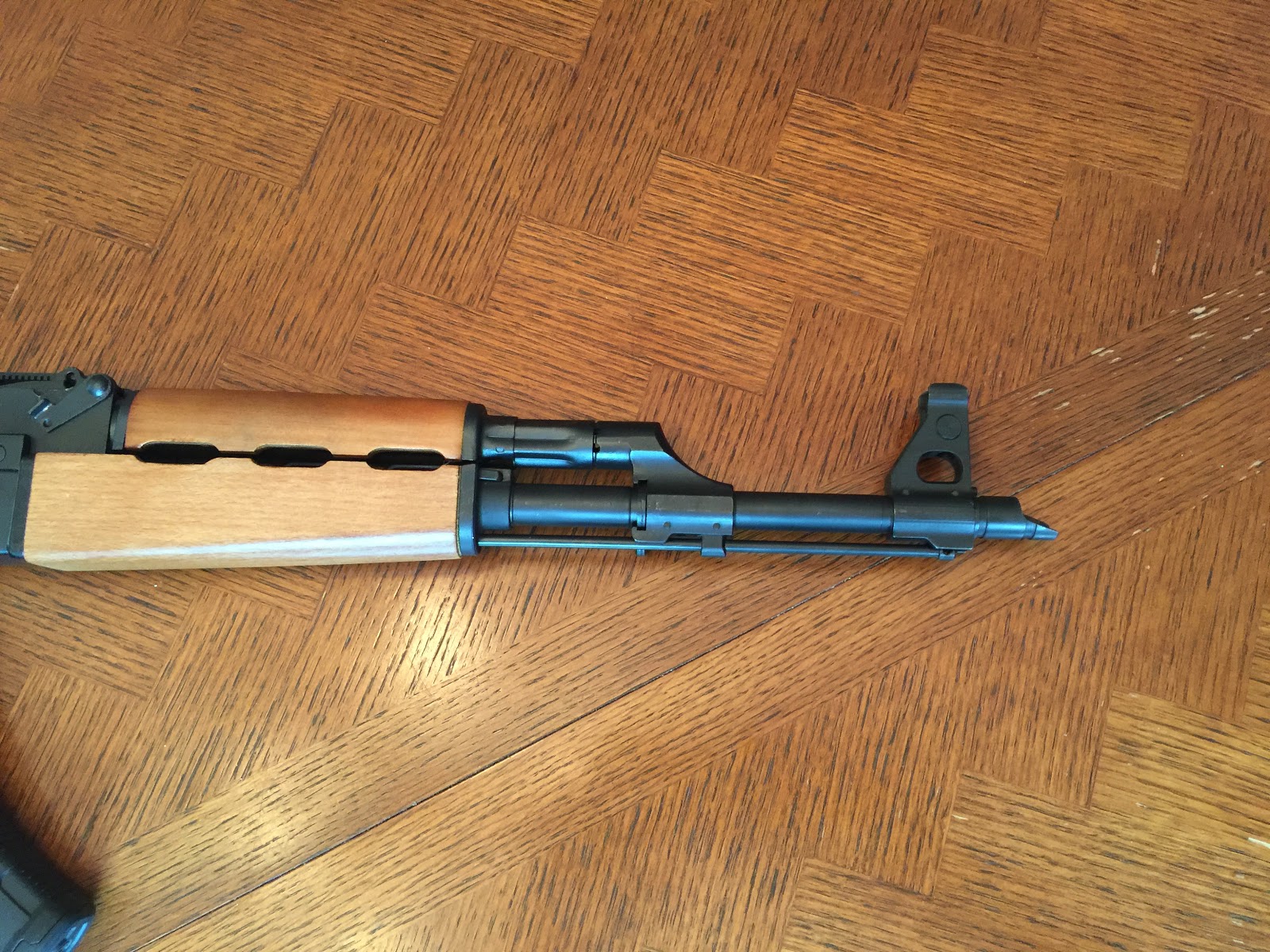
come free. Once the top cover is removed, the recoil spring is removed by pulling it out from the back of firearm, then the bolt carrier is pulled back and up out of the gun. This is where things differ from what I was accustomed to with other piston operated systems like the SKS or piston driven AR-15s. The piston rod is connected by means of a rivet to the bolt carrier. This makes the system simple and decreases the number of parts. The operator now has access to the trigger group and firing control components, the barrel to run a cleaning rod down, and the gas system. The AK, like the SKS can be further disassembled by removing the gas system. This allows for cleaning of the gas block and the gas port which is drilled into the top of the barrel.
 |
Aftermarket Accessories and Parts Compatibility
 |
| DoubleStar's AKRBY Receiver Block - AK Stock Adapter |
Since the N-PAP M70 is manufactured in Serbia (what used to be known as Yugoslavia), it is patterned off of the very popular Yugo M70 AK-47. Because of this aftermarket parts compatibility is limited to the use of Yugo M70 specific parts only. Fortunately, this platform has become more popular so more AK accessory and parts manufacturers are developing parts for the N-PAP. If you would like to utilize a standard AK-47/74 stock, you will need to purchase an adapter. The Yugo M70 stock that the N-PAP M70 comes equipped with, utilizes a long bolt that threads through the butt of the stock and into the rear of the stamped AK-47 receiver. N-PAP owners will find DoubleStar's sister company ACE Stocks sells a receiver adapter block, the AKRBY, for about $60 that will allow the use of any standard AK stock, like the fixed and side folding triangular shaped Khyber Pass stocks that are so popular with the AK crowd these days. There are a few other manufacturers making receiver blocks similar to this one, a simple google search will return several.
 |
| Magpul's Zhukov-S Stock for Yugo M70 AK's |
In 2016 Magpul decided to get into the AK
Aftermarket game with the release of their Zhukov furniture line. Magpul currently makes two types of AK stocks, the MOE AK Stock which resembles a triangular Khyber Pass styled side-folder and their Zhukov-S adjustable side-folding stock. The Zhukov-S has a version that will fit Yugo M70 patterned AK's and this is the one N-PAP M70 owners will need to use. The cool thing is this stock can be used without a receiver block/stock adapter. I would like to find out if the Magpul MOE AK stock can be used with a receiver block/stock adapter, but until I can get my hands on one, I can't make that conclusion. Based off pictures alone it appears that it will NOT work, since it features a standard AK/AKM receiver block adapter that appears to be built into the stock, which I assume is not removable. If anyone can clarify or correct me if I'm wrong it would be greatly appreciated. Please feel free to leave a comment or shoot me an e-mail to kellym.crow@gmail.com. The Magpul Zhukov line of accessories also includes a handguard for the AK platform which says it is not compatible with Yugo pattern rifles. I'm sure the competent operator or gunsmith could make this work by making a couple modifications to the handguard and their rifle, in particularly, removal of the sling strap point on the gas block would be a start. Of course if the handguard doesn't cover this, you would need a way to paint or touch up the metal after removing the sling strap point. Magpul also manufactures two MOE handguards, one that appears to have the cutout for the sling strap point on the gas block, the other which doesn't. I would love to hear from someone who knows if they can be or has modified any of Magpul's AK handguards fit Yugo M70 pattern AK-47's.
 |
| Midwest Industries Standard Yugo/Saiga AK Handguard |
as the Zastava N-PAP M70s do NOT have a grenade launcher sight on them, so I doubt any modification would need to be made to make these work. All of Midwest's systems come in one of three formats: Standard Picatinny Railed, M-Lok Compatible, or Key Mod Compatible. One unique feature of all the MI handguard
 |
| Midwest Industries Key Mod Yugo Handguard - this same handguard can be purchased in the M-Lok format. |

system's is that the top rail can be changed out to a propriety rail that features various mounting points for the most popular optics on the market; for example MI sells this optional top rail with mounts for Trijicon RMR, Burris, Leopuld, and Aimpoint. This feature provides perhaps the most solid mounting system for the AK-47 system. Midwest Industries manufacturers yet another AK-47 handguard that I find the most interesting, the MI Gen2 Extended AK-47/74 Handguard. This particular handguard is much longer, covering the entire gas system, providing more room to hold the rifle as well as more mounting spots. This is supposedly a Universal type of handguard and comes in M-Lok and Key Mod configurations, however there is no evidence suggesting that this WILL in fact fit the M70 patterned AK's and I have yet to discover someone online that has modified it to fit. This would be my first choice for a handguard system if I knew it would fit the Yugo pattern. One part of the Gen2 Extended Handguards that I know for a fact will NOT fit the Yugo system is the supplied MI Gas Tube that is included. I'm not sure why MI includes a new Gas Tube but I do know that the gas systems differ in length between your standard AK and the Yugo modeled AK's.
There are still yet, a few more manufacturers making parts and accessories for this AK-47. I have read and seen people using the Ultimak railed handguards and the Leapers UTG handguards, neither interest me as I typically use very high end components on my firearms. I'm not trying to be a price snob here either, I have found that you do get what you pay for with guns and their accessories. Live and learn is the best way to discover the parts that work for you. Some people may have better luck with a part than someone else, so I DO recommend you try everything you possibly can before making a decision. I personally have had bad experiences with anything made by Leapers and Ultimak, and I've seen countless reviews of the Ultimak rails where various user's $500 optic reticles melted because of the heat induced by the Ultimak rail system. Not sure why Ultimak's rails do this, after all, the best rails are made from metal, more specifically aluminum which does absorb heat, but it should also dissipate the heat as well. I suggest you do your research when searching for parts for this system, and use what you find others have made work. If you want to try something new, ask questions, write the manufacturer or other AK-47 users to see what their opinions are.
Conclusion
All-in-all, the Zastava N-PAP M70 AK-47 is a beast! From what little use I've had with it, I've found it to be reliable, accurate, and lots of fun to shoot! I can't wait to modify it and continue to practice with this platform so I can gain the skills I need to effectively manipulate the AK-47 in a combat situation. If you are looking for your first AK or if you're looking to add another AK-47 to the collection, you won't be disappointed with the Century imported N-PAP M70 and all it has to offer! As of today, this AK-47 can be had for under $630! I suggest you don't hesitate if you've been thinking of purchasing an AK, especially with the uncertainty the future holds for America and it's gun laws. Stay safe, shoot safe, and God bless America!
Subscribe to:
Posts (Atom)